

Key Factors That Influence Match Outcomes in Modern Football

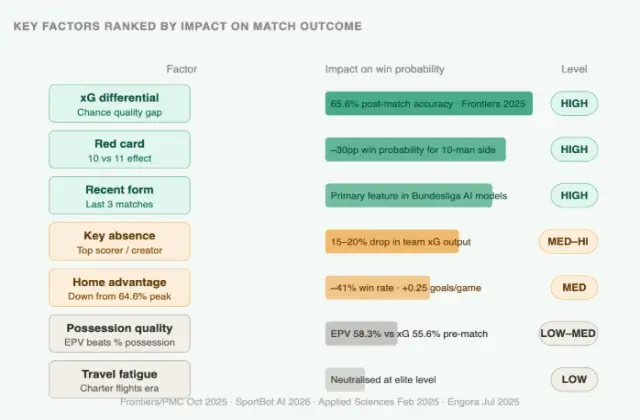
If you read any analysis of a match before it happens, you'll see that the home team is usually considered to have an advantage. That made sense – in the 1890s, home teams won almost two-thirds of games. At the moment, it's at 41%, and the slide has been steady across all leagues without exception (SportBot AI, 2026). The edge that once settled arguments has quietly become a small part of the text.
One thing didn't replace it. Some did. xG post-match gets the result right 65.6% of the time (Frontiers, 2025) — but this still means that for more than a third of results, there are things that don't show up in any model. One bad decision, a referee call that goes the wrong way, and the team is in trouble. It's important to know which of these actually change results, as this is what separates useful analysis from the rest.
,
Expected Goals: The Metric That Changed Everything
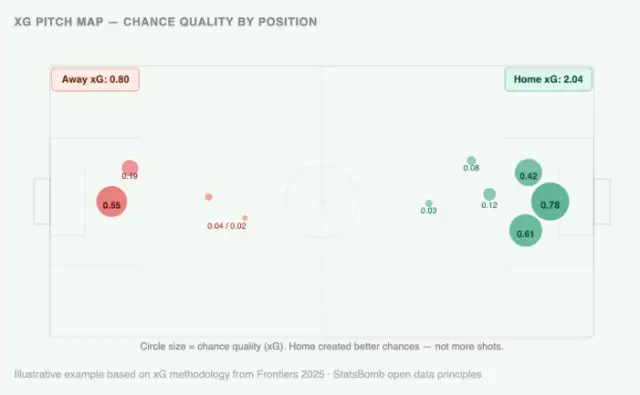
Two shots, from the same distance from the goal. One is a striker running towards the goal and getting close to the keeper. The other is a midfielder under pressure from thirty yards. Basic statistics record both shots. xG separates them – the first might have a 0.7 probability of happening, the second 0.04.
A 2025 Frontiers study looked at three full Bundesliga seasons and found that the results were 65.6% accurate. The most interesting finding came from the pre-match side: EPV measures how well a team performs when they have the ball, not just where the shots end up. Before the game started, EPV was 58.3%, while xG was 55.6%. Before the game, how you move the ball matters more. Once you've played, how you use your chances is more important.
Liverpool had a good chance of winning the league in 2024–25, but they didn't play that well in some games. The results were good for a short time. But they couldn't do it for a whole season. They didn't need to, because the numbers were already good enough.
The bottom line: if a team is doing better than expected for six or eight weeks, it probably won't last. A team that finishes below it over the same period is probably better than the table suggests. That's where most of the real advantage lies.

What Home Advantage Actually Means Now
The empty stadiums of 2020–21 settled the debate. If you remove the crowd, teams stop losing. Home sides quickly return to a neutral position (Tandfonline, 2024). So the effect is real. It just is not what it used to be.
In the past, referees' personal opinions were the main reason for home advantage. VAR has been making small improvements – the difference in penalties given and yellow cards shown to home and away teams has narrowed since its introduction (SportBot AI, 2025–2026). Charter flights and five-star hotels have also made people tired of travelling. Teams that are expected to win now arrive in roughly the same physical state as the home team.
What is left goes beyond logistics. In fact, in LaLiga, the Bundesliga, the Serie A, the Premier League, and the Ligue 1, home teams have won more aerial duels and made more key passes at home than away over the last eight seasons (Applied Sciences, 2025). If you play somewhere familiar, you will not feel as nervous. Having a full home end means you get something that you cannot see on a spreadsheet, but it is in the data.
At the moment, all of that, combined, is worth about 0.25 goals per game in English football (Engora, 2025). This is enough to change the probability, but not enough to decide the match.

The Variables Most Bettors Underweight
Research consistently shows that three factors are often overlooked by casual analysis.
First, let us look at how they have done in the last three matches. The Bundesliga AI models that predict outcomes with 65.6% accuracy use performance from the last three matches as a primary feature — not season averages, not league position. Teams are doing well or not doing well for reasons that season averages do not show. A team that has not kept a clean sheet for six weeks is a sign that its points total is not a true reflection of its performance.
Second, the effect of missing key events. When a top scorer does not play, a team's chances of scoring a goal go down by 15–20%. However, the bigger effect is psychological and tactical. When they know a specific threat is missing, opposition managers change their press and defensive shape. If one player is missing, the whole plan for the match changes.
Third, we need to look at how xG and finishing variance interact. Teams that have won a lot of games in a row usually end the season with a higher average than expected. However, this is not possible throughout the season because the results eventually return to normal. The key to making good predictions is knowing which teams are doing well (or not) relative to their usual performance.
When you've finished analysing the numbers, it's important to take a break. Habanero slots offer exactly that — fast, low-friction entertainment that doesn't demand the same analytical overhead as pre-match research.
FAQ
What is the best way to predict the results of a football match?
The xG differential post-match is a statistical factor that is 65.6% accurate in the Bundesliga across three seasons (Frontiers, 2025). Before the match, the expected possession value (EPV) based on the last three matches is better than the expected goal value (xG). No single metric is definitive — the best models use a combination of xG, recent form, and squad availability.
How important is it for a team to play on its home turf in a football match?
It matters, but not as much as it used to. The percentage of home wins fell from 64.6% in the 1890s to around 41% in 2025. In English football, home advantage is worth about 0.25 goals per game (Engora, 2025) — which is important for probabilities, but not enough on its own to decide the result.
Does how much a player has won in the past predict how they will win in the future?
Having raw possession is not a good predictor of success. The important thing is the quality of the ball — the EPV weights — and whether the ball's movement actually creates dangerous situations. A team that has the ball 60% of the time but plays slowly is less dangerous than one that has the ball 40% of the time but moves quickly into key areas.
What effect does a red card have on the chances of winning?
If a red card is shown to a team, there is a 30% chance they will lose. This depends on when the card is shown and how the match is going at that time. Early cards (before 30 minutes) are much more damaging. This effect is made even stronger when the card comes during a losing position.
What factors do modern AI football prediction models use?
The most accurate models (65%+) use a combination of last three matches' xG and EPV, home/away splits, squad availability, and other relevant factors such as the tournament stage. Two things that are not as important are the season averages and the league position. VAR data is increasingly used to build models of referee decisions.